
Why We Love Arbor Day!
Written by Sharon A. Findlay, MS
Director of Human Resources & Administration
"Love is like a tree, it grows of its own accord, it puts down deep roots into our whole being."
― Victor Hugo
If you’re thinking, Wait—trees? Isn’t this blog usually about mental health? The answer is yes… and also, we really love trees. Before I go any further, a quick history lesson:
The year is 1872, and journalist J. Sterling Morton is struck by how barren the plains of his home state of Nebraska appear. As a nature-lover, he proposes a mass tree-planting event and the seeds for what we now know as Arbor Day are planted (multiple puns intended)!
This brief peek into the past reveals more than you might expect. Why was it so important to cover the plains with trees? What else was happening at the time?
Pioneers were still settling the area, and without trees on the Great Plains, the soil was at the mercy of the wind. The land couldn’t be worked effectively for farming, limiting settlers’ ability to survive and thrive. Trees and their stabilizing root systems weren’t just a want they were a necessity.
And that’s what roots are: a necessity. They hold things together. They provide nourishment. They protect stability. They are life-giving and life-sustaining. Banyan trees, in particular, are known for their impressive root systems. They grow “prop roots” that begin high in the branches and extend downward toward the ground. Once these roots take hold, they form new trunks and root systems of their own. This unusual process allows banyan trees to grow outward in a nearly indefinite fashion, making them exceptionally strong and resilient.
It’s hard not to see how this mirrors our inner lives. So let’s take this metaphor inward for a moment: What are your “roots”? Not necessarily where you came from, but what grounds you, protects you, and gives you life. And what happens when those roots become ungrounded? Imagine a banyan tree with multiple trunk and root systems. If one of those systems is damaged or removed, the tree can become unbalanced—more vulnerable to wind, water, or other forces that might uproot it.
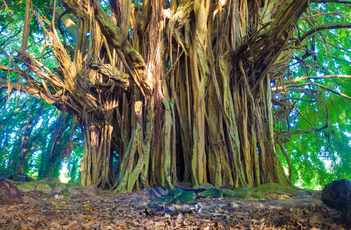
Humans are much the same. Often, it isn’t just one thing that leads someone toward healing and inner work. Sometimes it is—but more often, it’s a collection of experiences, stressors, or losses that gradually create a sense that something is out of balance.
That’s where the beauty of therapy comes into play. You don’t have to do this alone. Therapy can offer extra roots, extra shade, and extra support during a season when you need it most. It’s part of why our founder named the practice Banyan Tree Counseling.
This Arbor Day, I hope you’ll think of lots of things, including trees. I hope you’ll notice the beauty around you, thank the roots that sustain you, honor the roots that need more support—and maybe even smile at a tree.

Author Sharon Findlay brings nearly 20 years of experience in mental health, education, and organizational leadership to her work. Raised in a military family across the U.S. and abroad, she developed an early understanding of resilience and adaptability.
With a Master of Science in Organization Development focused on resilience in individuals and groups, Sharon takes a systemic, consultative approach that integrates human connection with organizational health. Her background in residential and therapeutic settings shaped her belief in the power of intentional, compassionate care. She is currently pursuing a Master of Arts in Counseling to further support individuals in their healing journeys.
