Banyan Tree Counseling & Wellness
  • Home
  • Book Appointment
  • About Us
    • FAQ >
      • FAQ en español
    • Our Story
    • Mission & Values
    • Events
    • YouTube Channel
    • Blog
    • Crisis Resources
    • JEDI Philosophy
  • Services
    • Services
    • Psychiatry | Medication Management
    • ADHD >
      • ADHD
    • Autism Assessments >
      • Book ADOS-2 Assessment
    • Coaching
    • Couples >
      • Gail Herbert, LCMHCA - Couples & Relationship Therapist
      • Yubi Aranda Sandoval, LCMHCA - Couples & Relationship Therapist
      • Angel Joel, LCMHCA - Couples Therapist & UNCG PhD Candidate | Winston-Salem, NC
      • Jennifer Cui, LCSW, Couples & Relationship Therapist
      • Emu Aragon, LCMHC - Couples & Relationship Therapist
    • Eating Disorders Therapy
    • Educational Consulting | Special Needs Advocacy >
      • Jordan Peterson, MEd, MA, LCMHCA - Educational Consultant & Advocate
    • Expressive Arts Therapy
    • OCD >
      • Andrew Shaw
      • Alexa Brenner DeConne, LCSW
      • Hayley McCraw, LCMHCA
    • Groups & Webinars
    • Nutrition >
      • Executive Nutrition & Performance Coaching
    • Parenting + Family Therapy
    • Play Therapy for Children >
      • Kyra Willeford
      • Alexa Brenner DeConne, LCSW
      • Gregoria Arreola-Meza, LCMHCA
      • Vika Hunter, LCMHCA
      • Yubi Aranda Sandoval, LCMHCA
    • Separation Counseling + Collaborative Parenting
    • Telehealth
    • Therapy for Teachers
    • Trauma
  • Meet Our Team
    • Meet the Whole Team!
    • Abby Olmstead, Registered Dietitian Nutritionist
    • Abbey Lefko
    • Alexa Brenner DeConne
    • Amber Miner
    • Andrew Shaw
    • Angel Joel
    • Autumn Martin
    • Brittany Proxmire
    • Britt Stewart
    • Bru Ramirez >
      • Bru Ramirez, Psicoterapeuta Licenciada
    • Christine Ridley
    • Emily Ortiz Badalamente
    • Emu Aragon >
      • Emu Aragon, Consejero Clinico
    • Gail Herbert
    • Gregoria Arreola-Meza >
      • Gregoria Arreola-Meza, Consejera Clinica
    • Hayley McCraw
    • Jennifer Cui
    • Kenzie Cameron
    • Kyra Willeford
    • Larisa King, Psychiatric Practitioner
    • Leslie "Les" Gura
    • Maggie Latta-Milord
    • Miriam Dineen, Psychiatric Practitioner
    • Sarah Vanderpool
    • Savannah Ornt
    • Sharon Findlay
    • Simone Banks
    • Tess Job
    • Tiffany Woods
    • Vika Hunter
    • Yubi Aranda Sandoval >
      • Yubi Aranda Sandoval, Consejera Clinica
    • Administrative Staff >
      • Brittany Proxmire
      • Emilia Lipnicki
      • Brooke Lichtenfels
      • Christal Stewart
      • Jamee Nunnery
    • Leadership Team >
      • Jamie Cullen
      • Chantal D. Hayes
      • Jordan Peterson
      • Graham Hayes
      • Sharon A. Findlay
  • Fees & Insurance
    • Fees + Insurance
    • Pay My Bill
  • Hiring
    • Hiring Clinical Lead/Supervisor
    • Hiring Therapist
    • Hiring Psychologist
    • Hiring PMHNP/PA
    • FAQ's for Interns
  • Client Portal

Hormones & Mental Health Across the Lifespan: How Puberty, Pregnancy, Postpartum, Perimenopause, and Menopause Shape Our Emotional Well-Being

5/11/2026

0 Comments


Larisa King, MSN, PMHNP-BC

Psychiatric Nurse Practitioner

Women are beautifully complex. Throughout our lives, our bodies move through a series of hormonal transitions that influence how we feel, think, rest, and function. Yet many women are never taught how deeply these shifts affect emotional wellbeing. For Women’s Health Week, I want to shine a light on what’s happening beneath the surface. Because if you’ve ever wondered, “Why do I feel this way?” the answer is often that your hormones are speaking—and you deserve to understand their language. 

Puberty marks the first major shift. It’s not just physical development; it’s a neurological remodel. As estrogen and progesterone rise, many girls experience mood swings, increased sensitivity, emotional reactivity, and changes in sleep. This is also when anxiety or depression may first appear—not as a sign of weakness or personal failure, but as the natural result of a brain undergoing rapid growth while hormones surge and settle. Offering young girls empathy, open conversations, and supportive community creates a foundation of emotional safety that stays with them into adulthood. 

Pregnancy brings another profound transition. Hormone levels rise higher than at any other time in life, which can create emotional sensitivity, increased worry, vivid dreams, and shifts in focus. For some women, pregnancy feels grounding; for others, it’s overwhelming or destabilizing. Both experiences are valid. Pregnancy affects every woman differently, and the most important thing is feeling supported, informed, and free to talk about what you’re experiencing—without fear of judgment. 

The postpartum period is one of the most intense hormonal transitions a woman can face. Immediately after birth, estrogen and progesterone drop rapidly, while a mother is also adjusting to profound physical recovery, feeding demands, identity changes, and—perhaps most difficult of all—sleep deprivation. Many mothers experience tearfulness, mood swings, irritability, anxiety, intrusive thoughts, or brain fog. While “baby blues” usually pass within a couple of weeks, ongoing distress may signal postpartum depression, anxiety, or OCD—very real, very treatable conditions that deserve compassion and support, not silence or shame.

Perimenopause, the years leading up to menopause, can feel like puberty in reverse. Hormones don’t simply decline; they fluctuate widely before settling, and those fluctuations can trigger anxiety, irritability, sudden mood shifts, sleep problems, emotional overwhelm, and cognitive fog that leaves many women saying, “I don’t feel like myself.” These experiences are real and often under-recognized. Women deserve validation, information, and supportive care during this season rather than being told it’s “just stress” or something to simply push through. 

Menopause itself marks twelve months without a menstrual cycle and a shift into a new hormonal baseline. Some women feel a sense of calm and clarity as moods stabilize. Others experience emotional changes, anxiety, sleep disruptions, shifts in libido, or a sense of loss. Like every stage of womanhood, menopause is not an ending but an evolution-- one that can bring renewed purpose when women feel informed and supported.  
Picture
One of the most beautiful truths about these transitions is that women were never meant to move through them alone. Historically, women gathered, shared stories, and supported one another through every season of life. Today, in a world that asks so much of us, these circles of connection are more important than ever. When women share their experiences, something powerful happens: we feel seen rather than misunderstood, validated rather than dismissed, and connected rather than isolated. We recognize that our emotional experiences are human, not flaws. We rediscover strength we didn’t realize we had. Community creates healing; hormones may influence how we feel, but sisterhood influences how we heal. 

As we talk openly about these hormonal shifts, it’s also important to acknowledge that for some women, emotional symptoms interfere with daily life in ways that deserve additional support. Psychiatric medication management can be a helpful, compassionate tool—not a last resort or sign of failure. When symptoms such as persistent anxiety, depression, panic, intrusive thoughts, irritability, or significant mood swings begin to affect work, relationships, sleep, or overall quality of life, a medication evaluation can create real relief. Some women benefit from antidepressants or anti-anxiety medications, others from targeted sleep supports or mood stabilizers, and some from a collaborative approach that includes hormonal treatment with their OBGYN. Pregnancy and breastfeeding deserve special consideration, but many medications are safe, and for some women, staying on or beginning treatment may support a healthier pregnancy or postpartum experience. Medication is never the whole story—it’s simply one tool that can help a woman feel more like herself so she can fully participate in her life. 

Your body is wise. Your emotions are valid. And your journey through hormonal change is part of what makes you resilient and deeply human. Whether you’re guiding a teenager through puberty, navigating pregnancy or postpartum, wrestling with perimenopause, or stepping into the transition of menopause, you deserve care, community, and compassion. If you ever wonder whether therapy, medication, or evaluation might help, reach out. You are not alone—and you never have to walk these changes by yourself.

When women support each other, we don’t just survive these transitions.
We thrive.

Picture
Larisa King
Author, Larisa King is a board-certified Psychiatric Nurse Practitioner with over 20 years of healthcare experience. She is deeply committed to providing compassionate, person-centered psychiatric care that helps patients feel heard, respected, and supported.

Before becoming a PMHNP-BC in 2019, Larisa spent more than 15 years as a psychiatric nurse, giving her an extensive background in caring for patients across all ages and life stages. Her dedication to mental health led her back to school to earn her advanced degree, driven by her passion to deliver care that is both clinically excellent and deeply human.
0 Comments

Healing Happens in Pieces: Why Slowing Down Is Essential to Emotional Processing

4/29/2026

0 Comments


Gail Herbert, MS, LPC, LCMHCA

Psychotherapist

When my boys were little, if one was crying, and I met them with “Stop crying, it wasn’t that bad,” they would sniffle and the painful feeling would be extended. If I instead met them with, “It hurts doesn’t it?” and rubbing their back, they would finish crying and return to playing. If I slowed and took my time with gentleness and comfort, the feeling moved along. If not, it seemed to get stuck. Moments like these have shaped how I understand what it really means to heal.

What is healing? I believe it is integration of the parts of a person. Dr. Dan Siegel says: “harmony [unfolds] with the five features of FACES flow: Flexible, adaptive, coherent (holding together dynamically over time), energized, and stable.” To be able to be flexible and adaptive to circumstances, to be coherent in thought, and to feel energized and stable in emotion, is to be able to flow with the ups and downs of life.

When healing is a goal–if you feel like something has shattered within–then slowing down is important, even if you want it to happen quickly. This can be frustrating, I know! But remember that healing happens continuously on a path. It is not a final destination that happens suddenly. And if you feel as though you have shattered, those pieces can be put together any way you want them to be. You can rebuild yourself into who you want to be.
Picture
So how does a person “slow down” emotionally? It means spending time with emotion. This does not mean sinking down into a pit of sadness. Rather, it means noticing feelings with curiosity and without judgment. A person may do this in meditation, while being creative, while walking or showering, any way that helps you feel emotion. It is critical to meet the emotion with curiosity and not judgment. For example, if I feel sad, I feel uncomfortable. I might close my eyes to tune into my body. Then I might notice I feel a little bit of fear in my stomach. Rather than trying to push it away with thoughts such as “You should not be feeling this way” or “Just get over it!” instead I might notice those thoughts and think “I wonder what is making me feel afraid?” Or I might picture myself as a child or friend. I might imagine giving that person a hug or being nurturing.

If I can learn to treat myself as I treated my boys, with slowness and nurturing kindness, healing will move along more quickly than with harsh criticism of myself. Give it a try. Let yourself feel emotion. This is where healing begins.

Picture
Gail Herbert
Author Gail Herbert is licensed in the states of North Carolina and Missouri and has over 20 years of experience in mental health, social services, and educational settings.

Trained in Emotionally Focused Therapy for couples and individuals, EMDR, and sand tray therapy, Gail has experience with those who have had painful or overwhelming circumstances, trauma, teens, adults, and couples.
0 Comments

Art For All: Where Creativity and Wellbeing Intersect

4/15/2026

0 Comments


Emily Ortiz Badalamente, MA, LCMHC, ATR-BC

Psychotherapist

As an art therapist, I often get the pleasure of hearing about people’s relationship with the word “art.” Some people talk to me about their favorite kind of art or craft. Others tell me about their favorite art projects from school. I hear about favorite museums, wine and paint nights with friends, or experiences like knitting that feel therapeutic and peaceful. It’s one of my favorite topics to discuss with others.

Often, I also hear people say “I’m not good at art.” I hear about how much people loved art class in childhood, but felt discouraged by grades. Or how they try to be creative, but perfectionism gets in the way. For all those who have a positive relationship with art, I meet just as many people who feel that art and creativity are out of reach.

This saddens me, because art and creativity can make us happier and healthier - no matter how “good” we are! A 2016 study showed that short artmaking experiences led to lowered cortisol levels, suggesting lowered stress. This was true regardless of type of artmaking, or if the person had any previous art experience (Kamail et al., 2016). Other studies suggest that enjoying art is linked to higher levels of wellbeing and happiness, as well as potential for lowered hypertension and inflammation (Lee et al., 2024).

This is obviously great for those who enjoy artmaking, or like being around art. But what about those who feel intimidated or bored by art? Because I am an art therapist, you can probably predict what I’m going to say…

Art is for everyone! Creativity is for everyone, and everyone is creative in their own way. I know that the “classic” ways of being creative, like drawing or painting, can often feel intimidating.

Because of this, I like to encourage people to pay attention to creativity that already exists in our everyday lives. Some examples of this are:
  • Choosing a new outfit combination, or dressing to evoke a certain feeling (like dressing “happy” or choosing colors that make you feel confident)
  • Redecorating, or hanging up new art on the walls of your room or home, and noticing how the art you own makes you feel or think
  • Stopping to enjoy a mural, or a creative display in a store window
  • Trying a new recipe, or a new flavor combination when making a meal
  • Decorating your planner pages with stickers or color combinations
  • Arranging your bookshelves in a way that pleases you

When we start to notice where creativity already exists in our lives, we can start to nurture it, and take it even further! If you’re interested in art and creativity, but are maybe unsure of where to start, here are a few ideas:
  • Make a scrapbook or album of photos that are meaningful to you. Choose colors, stickers, and words that connect to the emotions the photo evokes in you.
  • Go on a photo walk, and give yourself a photography theme. Using your camera or phone camera, take pictures of only red items, or only snap photos of leaves. Look up a photography scavenger hunt online to complete while you’re on a walk.
  • Think of art or craft styles that interest you, and look up some tutorials. YouTube and social media can be great resources, but don’t stop there. Make a plan to experiment and find some supplies. Some ideas to look up are tie dying, polymer clay crafts, stampmaking, origami, or paper mache. For some added creativity, try to use materials you might already have on hand!
  • Go see some art! Check out a museum, or look up local galleries to visit. Find murals or public art in your area, and take yourself on a field trip. Ask yourself, what inspires you? What styles, colors, and subjects do you like or dislike?
  • Take a beginning art or craft class. Some great local options in Winston-Salem are Sawtooth School for Visual Arts, Forsyth Tech’s Personal Enrichment Classes, Dabble Art Bar, Art Shac, and Village Fabric Shop.

Whether you are interested in making art, or just appreciating it, I encourage you to nurture your own connection with creativity. It can be a great way to better know yourself, learn new skills, or challenge your worldview. And you might just find ways to feel happier and healthier along the way!
Picture
If you’re interested in going further, and would like to explore how creativity can help you work on your mental health and wellbeing goals, consider working with an art therapist or creative arts therapist. For more information about art therapy, please visit The American Art Therapy Association. To learn more about the creative art therapies, like music therapy, drama therapy, and dance/movement therapy, please visit the National Coalition for the Creative Arts Therapies Associations.

References
Kaimal, G., Ray, K., & Muniz, J. (2016). Reduction of Cortisol Levels and Participants & Responses Following Art Making. Art therapy: Journal of the American Art Therapy Association, 33(2), 74-80. https://doi.org/10.1080/07421656.2016.1166832
​
Lee, S. S., Lee, S. H., & Choi, I. (2024). Do art lovers lead happier and even healthier lives? Investigating the psychological and physical benefits of savoring art. Psychology of Aesthetics, Creativity, and the Arts, 18(3), 279–286. https://doi.org/10.1037/aca0000441

Picture
Emily Ortiz Badalamente
​Author Emily Ortiz Badalamente is a Board Certified Registered Art Therapist (ATR-BC) and Licensed Clinical Mental Health Counselor who works with teens (age 16+) and adults experiencing ADHD, life transitions, grief and loss, trauma, anxiety, and self-esteem issues. Emily's warm and empathic style lends to a trusting and respectful therapeutic relationship with her clients. Her strengths based approach allows clients to gain insight, attain achievable goals, and create a fulfilling, joyful, and authentic life. Emily’s approach to therapy is integrative; she believes in addressing the spiritual, emotional, and physical needs of her clients so they may attain self acceptance and healing.  
0 Comments

5 Tips for the Anxious Athlete

3/3/2026

0 Comments


Sarah Vanderpool, LCMHC, NCC, LPSC

Psychotherapist

In addition to being a licensed psychotherapy, I am also a former competitive athlete and current coach. With the latter role, helping my athletes prepare for competition, both mentally and physically, is my job. But as parents, as coaches, and as athletes, what do we do when our brain becomes unmanageable and negatively affects athletic performance? While there is certainly no “one size fits all,” I’ve used my knowledge as a coach, parent, and mental health professional to compile what I think is a helpful list of things to consider for athletes who have pre-competition anxiety.

Feeling anxious before a big game or competition is completely normal, but when nerves start to interfere with your performance or enjoyment, it’s time to take action. Many athletes struggle with pre-game jitters, overthinking, or fear of failure, but with the right mindset and strategies, anxiety can actually become a powerful source of focus and motivation.
Picture
​1. Fuel Your Body
Put good in, get good out. Athletes must properly fuel their body for optimal competition results. This includes proper nutrition throughout practices, days/hours leading up to, and after the main event. A well-fueled body performs better and recovers faster. See what Abby Olmstead, Registered Dietitian Nutritionist, has to say about fueling your body properly for competition: Fueling your Body for Game Day.


2. Be a Goldfish
Goldfish have a short memory — and that’s a good thing. Finding the mental toughness to shake off mistakes and stay focused on what is happening in the moment can be challenging, but practice makes permanent. Keep moving forward and focus on what’s next – you got this!

3. Visualization
Mentally rehearse success. Picture yourself performing confidently and skillfully. See it from a 3rd-person perspective (like you’re watching yourself from the stands) and from your own eyes. This is what people mean when they say “eat, sleep, and breathe your sport”. Utilize positive visualization any time you have a free moment and make it part of your pre-game routine.

4. Pre-Game Routine
Routine builds confidence and reduces nerves. Everybody’s pre-game routine might look a little different, but the goal is the same – train your muscle memory well before game time. Include sleep, nutrition, breathing, and visualization. Add music, positive self-talk, or a specific warm-up — whatever helps you lock in. If you’re not sure what to do, ask your coach and/or teammates for help. Or your trusty mental health therapist 🙂

5. Breathe
Slow breathing = calm body and clear mind. When anxiety rears its unwanted head, you’ll want to have some coping skills in your back pocket to help mitigate the frustrating effects anxiety can have on your body and your performance. When you can control your breathing, it helps regulate heart rate, which is directly impacted by anxiety. Slow your breathing, and make your exhale longer than your inhale. Try 4-7-8 breathing:
  • Inhale for 4 seconds
  • Hold for 7 seconds
  • Exhale slowly for 8 seconds
Pro tip: Struggle to exhale slowly? Hiss like a snake to control the airflow.

You have more power over your mind than you realize. So go, right now, and practice your breathing and visualization, and make a few notes on what a pre-game/competition routine might look like for you. In part two, I’ll talk more about managing adrenaline, and practicing for permanence, not perfection.

Picture
Sarah Vanderpool
Author Sarah Vanderpool, LCMHC, NCC, LPSC is a Licensed Professional School Counselor and Licensed Clinical Mental Health Counselor. She specializes in working with children, adolescents, and college-aged adults. As a former competitive athlete, Sarah has a niche in sports psychology and enjoys supporting youth and adults who participate in both competitive and recreational athletics alike to overcome psychological obstacles such as stress, anxiety, concentration, confidence, anger, and depression.
0 Comments

Through a Child’s Eyes: What If They’re Not Acting Out But Learning?

2/27/2026

0 Comments


Gregoria Arreola-Meza, MS, LCMHCA, LPSC, NCC

Psychotherapist

Recall a time when you were expected to know how to do something without any prior knowledge. How did you feel? You may have felt confused, frustrated, or even hurt by the implication that you should have known something you didn’t. In my work with children in therapy,  I continually challenge myself to understand that a child's approach to a situation is shaped by the skills they possess at that time. As adults, we may unconsciously label children's behaviors that do not align with our expectations as attention-seeking, mischievous, or overreacting to situations.

We might think to ourselves, "Why would you think that was a good idea?" To challenge this perspective, I’d like to share an anonymous quote I once stumbled upon: "The sooner we let go of the expectation that children are capable of adult-like behavior, the easier it will be to tolerate their mistakes." I recognize how difficult it can be to understand why children do not always consider consequences before acting on their emotions. I invite you to reflect on the times when we, as adults, have struggled with this ourselves. It can indeed be challenging.
Picture
By removing the adult lens, we may realize that children are not seeking attention, but rather connection. They may not intend to be mischievous; instead, they might simply be struggling to use conflict-resolution skills they have never been taught. Additionally, what we perceive as overreactions may simply reflect a child’s current level of understanding. It would be unfair to expect someone to know something they are not familiar with. 

Through my work, I have learned that when a child shares their experiences with me, it is their way of expressing "I promise I am trying my best… with what I know.” By approaching their stories with curiosity, non-judgment, and empathy, I am able to create a space where trust and learning can begin. This may involve helping children identify positive versus negative choices, distinguish a positive consequence from a negative one, and express which emotions may arise when deciding one over the other. By striving to view a child's story through their eyes, I come to understand behavior as a cue for growing and learning rather than as attention-seeking, mischief, or an overreaction. 

How would you navigate a world that expects you to know it all if you never had a chance to learn it?

Picture
Gregoria Arreola-Meza
​Author Gregoria Arreola-Meza, MS, LCMHCA, LPSC, NCC is a bilingual (English and Spanish) Licensed Clinical Mental Health Counselor Associate and Licensed Professional School Counselor in North Carolina who works with children, adolescents, and adults, providing empathetic support that helps clients build healthy coping skills and expressive outlets while honoring each person’s story, identities, cultural background, values, and lived experiences.
0 Comments

If Your Body Parts Could Talk...

8/17/2020

1 Comment


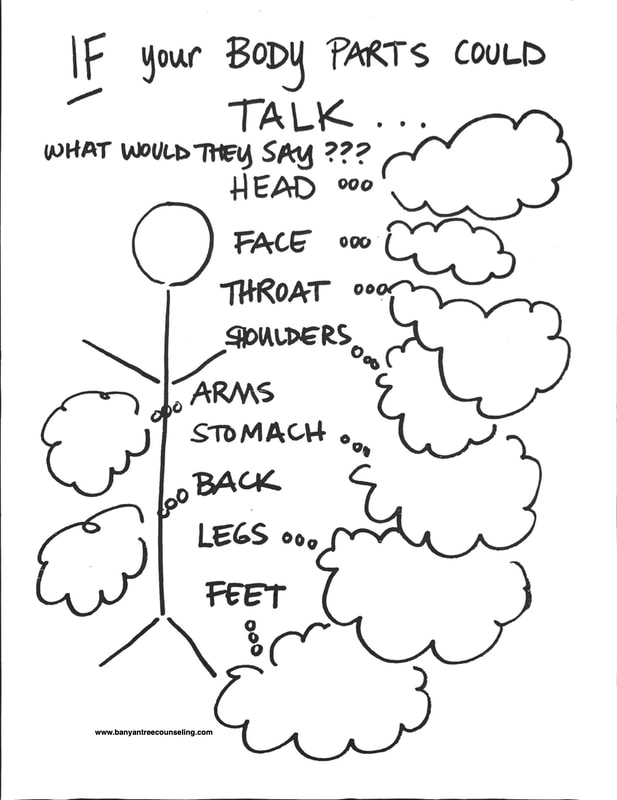
If your body parts could talk, what would they say?

I've used this worksheet with my own children, with students I've taught, and with clients, both children and adults. Teaching kids to "tune in" to their bodies is an essential skill and doesn't always come naturally.

There are so many benefits to learning this skill! One is emotional regulation-- kids who can listen to their body have an easier time managing and coping with their feelings, especially the really big ones, like anger, disappointment, fear, frustration, guilt, sadness.. .

They feel more capable, confident, have a more secure sense of self.

They have less behavioral problems, better social skills with peers, more empathy and supportive relationships...

It's not just a skill for kids., Adults benefit in similar ways, too, with overall mental stability, positive sense of self, solid relationships, increased career satisfaction. 

Take a moment today to tune inward,. Breathe in for 4 seconds, hold for 7, and slowly release for 8. Then scan your body and really listen to what each body part is telling you. Maybe some are silent, while others are screaming!

That's ok, no judgement.

All you have to do is listen.

Click to download the PDF to use at home.
if_body_parts_could_talk.pdf
File Size: 452 kb
File Type: pdf
Download File

Picture
1 Comment

    Banyan Tree Counseling & Wellness

    We are a team of licensed clinicians with a holistic, strengths-based, and evidence-based approach. We offer counseling for people of all ages, life coaching, group therapy, educational consulting and advocacy, assessments, and dietary nutrition services.
    ​

    Categories

    All
    Active Listening
    Adolescents
    Anxiety
    Athletes
    Children
    Conflict
    Couples
    COVID-19
    Depression
    Effective Communication
    Emotional Regulation
    Empathy
    Family
    For Clinicians
    Grief
    Holidays
    Life Coaching
    Medication
    Mindfulness
    Monday Message
    Nutrition
    Office Photos
    Parenting
    Play Therapy
    Poetry
    Psychoeducation
    Sleep
    Trauma

Counseling/Psychotherapy    •    Psychiatric Services     •     Medication Management    •     Nutrition counseling
   COUPLES & FAMILIES      •     CHILDREN & TEENS     •     EDUCATIONAL ADVOCACY

Picture
​Phone:

ph: (336) 448-4451
fax: (336) 450-1884

Winston-Salem Locations:

3303 Healy Dr Suite B 

​3305 Healy Dr


1409-J Plaza West Road

Winston Salem, NC 27103

**In-person and telehealth!
Wilmington Location:

​206 N. 4th St, Suite 15
Wilmington, NC 28401
​

**Wilmington is accepting telehealth clients. In-person availability Summer, 2026!**
Picture
If you are in a life threatening situation call 1 (800) 273-8255 or use these resources to get immediate help.

​HIPAA Notice of Privacy Practices


© 2015-2026 Banyan Tree Counseling PLLC  |  Banyan Integrated Health PLLC  |  Banyan Tree Wellness LLC  |  All Rights Reserved.
All content on this website, unless otherwise specified, is the sole property of Banyan Tree Counseling & Wellness and is protected by copyright laws.
Any unauthorized reproduction, distribution, or use of this content is strictly prohibited and may result in legal action.
  • Home
  • Book Appointment
  • About Us
    • FAQ >
      • FAQ en español
    • Our Story
    • Mission & Values
    • Events
    • YouTube Channel
    • Blog
    • Crisis Resources
    • JEDI Philosophy
  • Services
    • Services
    • Psychiatry | Medication Management
    • ADHD >
      • ADHD
    • Autism Assessments >
      • Book ADOS-2 Assessment
    • Coaching
    • Couples >
      • Gail Herbert, LCMHCA - Couples & Relationship Therapist
      • Yubi Aranda Sandoval, LCMHCA - Couples & Relationship Therapist
      • Angel Joel, LCMHCA - Couples Therapist & UNCG PhD Candidate | Winston-Salem, NC
      • Jennifer Cui, LCSW, Couples & Relationship Therapist
      • Emu Aragon, LCMHC - Couples & Relationship Therapist
    • Eating Disorders Therapy
    • Educational Consulting | Special Needs Advocacy >
      • Jordan Peterson, MEd, MA, LCMHCA - Educational Consultant & Advocate
    • Expressive Arts Therapy
    • OCD >
      • Andrew Shaw
      • Alexa Brenner DeConne, LCSW
      • Hayley McCraw, LCMHCA
    • Groups & Webinars
    • Nutrition >
      • Executive Nutrition & Performance Coaching
    • Parenting + Family Therapy
    • Play Therapy for Children >
      • Kyra Willeford
      • Alexa Brenner DeConne, LCSW
      • Gregoria Arreola-Meza, LCMHCA
      • Vika Hunter, LCMHCA
      • Yubi Aranda Sandoval, LCMHCA
    • Separation Counseling + Collaborative Parenting
    • Telehealth
    • Therapy for Teachers
    • Trauma
  • Meet Our Team
    • Meet the Whole Team!
    • Abby Olmstead, Registered Dietitian Nutritionist
    • Abbey Lefko
    • Alexa Brenner DeConne
    • Amber Miner
    • Andrew Shaw
    • Angel Joel
    • Autumn Martin
    • Brittany Proxmire
    • Britt Stewart
    • Bru Ramirez >
      • Bru Ramirez, Psicoterapeuta Licenciada
    • Christine Ridley
    • Emily Ortiz Badalamente
    • Emu Aragon >
      • Emu Aragon, Consejero Clinico
    • Gail Herbert
    • Gregoria Arreola-Meza >
      • Gregoria Arreola-Meza, Consejera Clinica
    • Hayley McCraw
    • Jennifer Cui
    • Kenzie Cameron
    • Kyra Willeford
    • Larisa King, Psychiatric Practitioner
    • Leslie "Les" Gura
    • Maggie Latta-Milord
    • Miriam Dineen, Psychiatric Practitioner
    • Sarah Vanderpool
    • Savannah Ornt
    • Sharon Findlay
    • Simone Banks
    • Tess Job
    • Tiffany Woods
    • Vika Hunter
    • Yubi Aranda Sandoval >
      • Yubi Aranda Sandoval, Consejera Clinica
    • Administrative Staff >
      • Brittany Proxmire
      • Emilia Lipnicki
      • Brooke Lichtenfels
      • Christal Stewart
      • Jamee Nunnery
    • Leadership Team >
      • Jamie Cullen
      • Chantal D. Hayes
      • Jordan Peterson
      • Graham Hayes
      • Sharon A. Findlay
  • Fees & Insurance
    • Fees + Insurance
    • Pay My Bill
  • Hiring
    • Hiring Clinical Lead/Supervisor
    • Hiring Therapist
    • Hiring Psychologist
    • Hiring PMHNP/PA
    • FAQ's for Interns
  • Client Portal