Christine Ridley, MSW, LCSW, ADHD-CCSPPsychotherapist The holidays can be tough for some people, with a variety of emotions showing up. This holiday season, I felt some melancholy. My grandfather entered hospice. I watched my mother grieve her father. I spent time in a hospital room, a memory care unit, and by a hospital bed while others were celebrating togetherness. How many of us find the joy of the holiday season difficult to hold while we are aware there is an empty seat at the table? Grief is many things and is not limited to the death of a loved one. Grief can also arise from the loss of a job, having to detach from a friend, ceasing contact with a family member due to their active addiction and not wanting to enable their behavior, experiencing the ‘empty nest’, or missing a previous time in your life that you cherished. A Swiss-American psychiatrist, Elisabeth Kubler-Ross, coined the 5 Stages of Grief based on her work with terminally ill patients and they have been widely adapted to the framework of grief. Note that these stages are fluid and not linear.
In my counseling work, I use a skill called dialectics from the Dialectical Behavioral Therapy (DBT) framework to hold grief. Dialectics is a philosophical framework in which two seemingly opposite truths can coexist. With grief, dialectics sounds like this: “I am devastated by their loss and I am relieved they are no longer in pain.” By holding two opposite truths at the same time, we are not invalidating that there is pain here, we are acknowledging the pain, while noticing what is around that pain, so that we can better move through the emotions without judgment, without pushing away the pain, and honoring it. I often encourage my clients to have a daily practice or ritual where they honor their grief. You may choose to have a sacred space where you sit daily. This is a space that is comfortable for you, whether it is outside on a park bench or inside your home in your favorite chair. You may set a timer for 15 minutes and light a candle. Leaning into stillness, name your emotions, notice the physical sensations that may be there in your body, and honor them. For example, “I am noticing sadness here. Sadness feels like tears forming behind my eyes and heaviness in my chest. To honor this, I am going to let my tears flow, open up my chest, breathe in some calm and breathe out sadness. To honor the sadness I feel today, I am going to notice that while I am sad, I notice I am allowing myself to heal in brave ways.” Blow the candle out and this is the end of the practice. By allowing yourself time to have this practice daily, this prevents the build up of grief and allows for healing, one day at a time. May you find peace in your healing journey.
0 Comments
Many of us are carrying a lot right now. Heavy hearts. Big feelings. A mix of sadness, anger, fatigue, and worry... sometimes all at once. This week, I want to gently invite you to do two simple things. First, let yourself feel it. There’s no right way to hold this moment. Cry if you need to. Take a long walk. Light a candle. Hug someone you love. Sit quietly and breathe. Give yourself permission to be human. Second, remember that you are not alone. Even in hard seasons, we find each other. We are the helpers: showing up quietly, steadily, imperfectly, and with care. I’d like to share a song that has been grounding me: Melanie DeMore singing Sending You Light. Take a few minutes this week to close your eyes and breathe. Let it wash over you. 🎧 https://youtu.be/cIsZuoNFtXg I’m sending you light, steadiness, and care... for who you are and how you keep showing up, even when it’s hard. And if this season feels heavier than you can carry alone, know that we are here for you. You don’t have to be in crisis to reach out. Sometimes having a warm, steady, compassionate space just to talk things through can make all the difference. Look for the good. There is always so much good among us. We will make it through together. Always. 💛
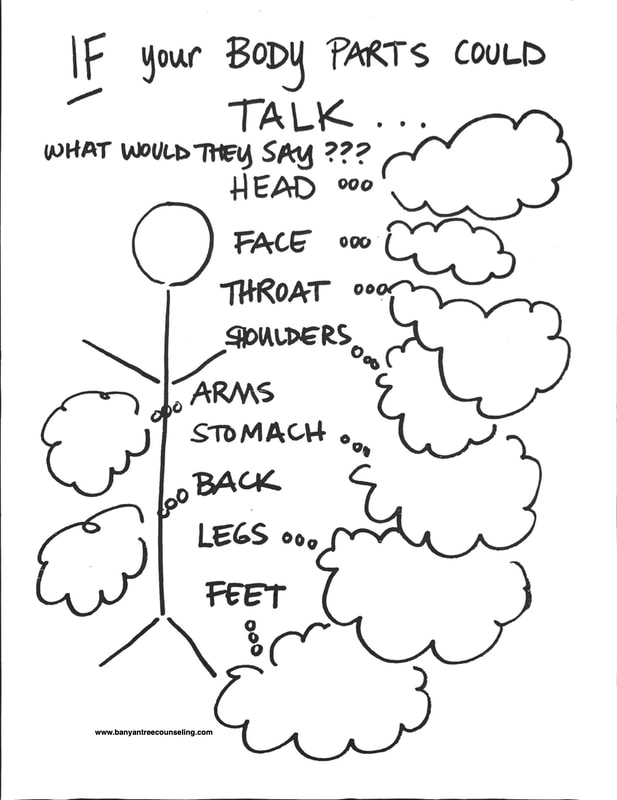
If your body parts could talk, what would they say?I've used this worksheet with my own children, with students I've taught, and with clients, both children and adults. Teaching kids to "tune in" to their bodies is an essential skill and doesn't always come naturally. There are so many benefits to learning this skill! One is emotional regulation-- kids who can listen to their body have an easier time managing and coping with their feelings, especially the really big ones, like anger, disappointment, fear, frustration, guilt, sadness.. . They feel more capable, confident, have a more secure sense of self. They have less behavioral problems, better social skills with peers, more empathy and supportive relationships... It's not just a skill for kids., Adults benefit in similar ways, too, with overall mental stability, positive sense of self, solid relationships, increased career satisfaction. Take a moment today to tune inward,. Breathe in for 4 seconds, hold for 7, and slowly release for 8. Then scan your body and really listen to what each body part is telling you. Maybe some are silent, while others are screaming! That's ok, no judgement. All you have to do is listen. Click to download the PDF to use at home.
|
Banyan Tree Counseling & WellnessWe are a team of licensed clinicians with a holistic, strengths-based, and evidence-based approach. We offer counseling for people of all ages, life coaching, group therapy, educational consulting and advocacy, assessments, and dietary nutrition services. Categories
All
|
||||||||||
|
Phone:
ph: (336) 448-4451 fax: (336) 450-1884 |
Winston-Salem Locations:
3303 Healy Dr Suite B 3305 Healy Dr 1409-J Plaza West Road Winston Salem, NC 27103 **In-person and telehealth! |
Wilmington Location:
206 N. 4th St, Suite 15 Wilmington, NC 28401 **Wilmington is accepting telehealth clients. In-person availability Summer, 2026!** |